

Question hub
Independent School Branding: Questions Schools Actually Ask
These are 42 questions independent school leaders ask about brand strategy, rebranding, cost, messaging, visual identity, rollout, and choosing a branding partner. Each answer is short and direct, written by Trey Boden, who spent ten years at The Mount Vernon School serving as Chief Brand Officer, Creative Director, and Innovation Diploma adjunct faculty.

By Trey Boden, Founder and Principal of Roar
Ten years at The Mount Vernon School, serving as Chief Brand Officer, Creative Director, and Innovation Diploma adjunct faculty.
Published
Last updated
| A refresh | A rebrand | |
|---|---|---|
| What it changes | How the brand looks | The strategy underneath the look |
| It fits when | What your school stands for still holds true and only the look feels dated | The school has changed, or the positioning was never clear |
Strategy basics
What is school brand strategy?
School brand strategy is the full set of decisions about how your school is known. It starts with what you believe and who you exist for. It names the position only your school can hold. It sets your personality, your voice, and the promise you make to families. And it shapes how the school looks and feels everywhere a family meets it. The tour, the logo, the email, the hallway, the way a teacher answers a question. That is all brand. Strategy makes those impressions intentional instead of accidental. Most schools treat brand as a logo and a tagline. It is the whole system underneath them. Get it right, and everything you say and everything you build grows from one clear idea. Get it wrong, and you end up with a hundred disconnected impressions and pay to look like everyone else.
Case study
Mount Vernon Presbyterian School
Ten years of brand building inside one of Atlanta's most innovative schools. A decade, 300+ projects a year.
See the case study
How is brand strategy different from school marketing?
Strategy is what your school decides to be known for. Marketing is how you make it known. Strategy comes first and sets the direction. Marketing carries it into the world through your website, your tours, your ads, and your social feed. Marketing without strategy is why schools spend more every year and still sound like the school next door. When the strategy is clear, the marketing gets cheaper and better, because every piece is saying and showing the same true thing.

Case study
Venture Academy
A North Star that sets the vision in 100 words or less. One compass, four pillars, 100 words or less.
See the case study
What is a positioning statement for a school?
A positioning statement is the one sentence that says who your school is for and why it is the right choice for them. It is an internal tool, not a tagline. It keeps every decision honest, from the messaging to the visual identity to the programs you put forward. A strong one is specific enough that another school could not sign their name to it. If yours could describe the school down the road, it is not done yet.
What do families actually look for in a private school?
Families are looking for fit and belonging for their child. They want to know their kid will be known here and will do well here. That rarely matches what schools lead with, which is programs, test scores, and college lists. Those things are evidence. The real driver is a feeling that this is the place their child becomes more themselves. The research backs this up. In a Friedman Foundation survey of 754 private school scholarship families, the top reasons for choosing a school were discipline, learning environment, smaller classes, safety, and individual attention. Only 5.4 percent named higher test scores as the single most important factor.
Does our school really need a brand, or just good word of mouth?
Word of mouth is your brand. It is just the unmanaged version. Every family already describes your school to other families. Brand strategy makes sure they describe it clearly and consistently, in words that help the next family choose. A strong brand does not replace word of mouth. It gives your best families better words and a clearer story to pass on.
Knowing when to rebrand
When should a school rebrand?
A school should rebrand when something real has changed and the brand no longer tells the truth about the school. The honest triggers are enrollment softening, a merger or a new division, a strategic plan the current brand cannot carry, or a school that has grown into something its story no longer describes. A dated logo is not a reason on its own. If the school your families experience is better than the school your materials show, that gap is the signal.
What are the signs it is time to rebrand?
The clearest sign is that your own people describe the school differently from each other. Ask five staff what makes it special and you get five answers. Other signs pile up from there. Admissions feels harder to explain. Your materials look like they came from different schools. The brand predates a real change in who you are. One of these is worth watching. Several at once means it is time.
Do we need a new logo or a new strategy?
Almost always strategy first. A new logo on an unclear strategy just repaints the confusion in nicer colors. Get clear on what the school stands for and who it is for, and the design decisions get easy. Sometimes the logo genuinely is the problem, when it is dated or broken or says the wrong thing. Even then, settle the strategy before you redraw it, so the new mark actually means something.
Is our school's brand hurting enrollment?
It can be, and the tell is clarity. If families cannot quickly say what makes your school the right choice for them, the brand is making their decision harder than it needs to be. Enrollment usually follows clarity. When a school knows who it is and shows it consistently, the right families see themselves in it and the wrong-fit families move on. When the story is fuzzy, even great schools get passed over. Look at where families drop off. Few inquiries points to awareness. Families who tour but do not apply point to a gap between what your materials promise and what they see on campus. Accepted families who choose another school point to unclear value. Check the basics before blaming the brand, because slow inquiry follow-up and tuition worries produce the same symptoms. A brand diagnostic shows you where the clarity is leaking.
Should a school rebrand or just refresh?
A refresh updates how the brand looks. A rebrand revisits the strategy underneath it. Here is the test. If what your school stands for still holds true and only the look feels dated, you need a refresh. If the school has changed, or the positioning was never clear, a new coat of paint will not fix it. That is a rebrand. Most schools reach for the big one when a refresh would do. A few do the opposite.
Cost and investment
What does a school rebrand cost?
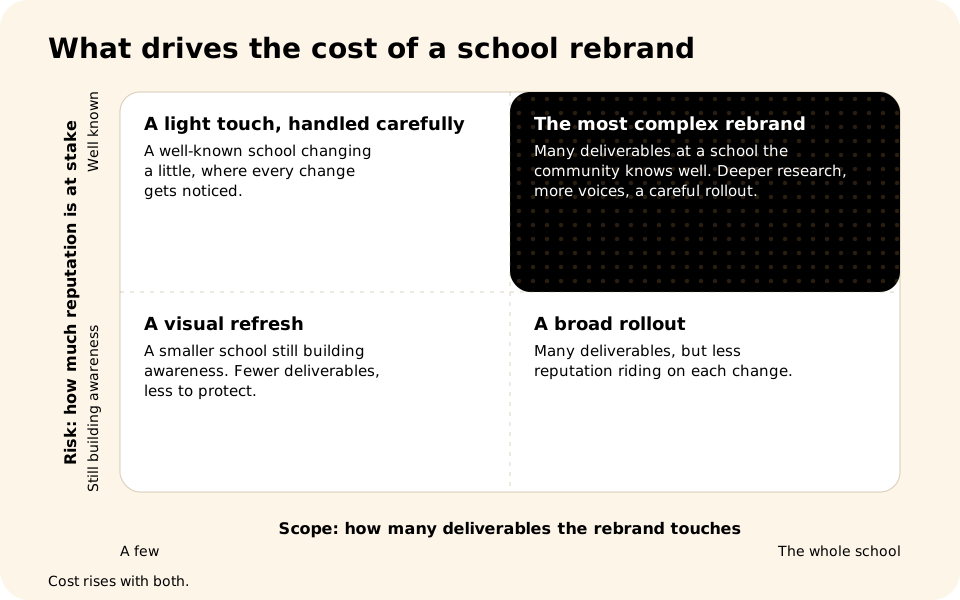
The cost of a school rebrand depends on how much the rebrand touches and how much is at stake, with most projects ranging from $20,000 to $80,000 or more. The first factor is scope, meaning the number of deliverables the rebrand reaches, from a visual refresh to a strategy-led rebrand to a whole-school rollout across the website, print, signage, and campus. The second factor is risk, which comes from the school's reputation. A school that is well known and well loved in its community has more to protect, so its rebrand needs deeper research, more voices at the table, and a more careful rollout than a smaller school that is still building awareness. Schools should also plan for implementation costs such as website development, photography, signage, uniforms, and printing, which often sit outside the agency fee. A board should see the rebrand as a multi-year investment in enrollment and advancement, and a short scoping conversation is the fastest way to get a real number for your school.
What drives the price of a rebrand?
Four things move it most: how deep the research goes, how many audiences and divisions are involved, how much gets built new versus refined, and how far the rollout reaches from the website to signage to the campus itself. A logo refresh sits at one end. A full strategy, identity, and rollout across a multi-division school sits at the other. Name your actual scope and you can size it yourself before a number ever comes up.
How do we budget for a rebrand?
Budget it as a multi-year investment in enrollment and advancement, not a one-time marketing expense. The brand touches admissions, retention, and giving for years, so it earns its keep over time. Decide the real scope first. A phased approach lets you start with the strategy and the highest-visibility pieces, then roll out the rest as the budget allows. That keeps the work honest and the spend paced to what the school can carry.
How do we justify the investment to the board?
Tie it to what the board already cares about: enrollment, retention, and advancement. A clear brand makes the school easier to choose and easier to give to. Frame the rebrand as strategy that moves those numbers, not as design taste. Bring the real story of where the current brand is costing you, in families who could not explain the school or gifts that never closed. The numbers are the school's own. The argument is that clarity pays for itself.
Process and timeline
How long does a school rebrand take?
Most strategy-led school rebrands take six to twelve months from kickoff to public launch. A visual refresh on a settled strategy moves faster. Discovery and strategy take the longest, because that is where the real decisions get made. Messaging and identity move faster once the strategy is set. Rollout stretches or shrinks with how much has to change. What usually adds time is the calendar more than the work: board cycles, approvals, and the school year itself. Protect the strategy phase. Rushing it is where rebrands go wrong. Work backward from your admissions calendar so the website, materials, and tour tell the new story before your next recruiting season.
What are the phases of a school rebrand?
A rebrand moves through five phases and the order matters. It starts with discovery and research, learning how the school is really seen. Strategy and positioning come next, deciding what to stand for. Then messaging sets the language everyone uses. Identity builds the visual system that carries it. Rollout takes it all live. Every phase depends on the one before it. That is why starting with the logo breaks the whole thing.
How do you rebrand a private school?
You rebrand a private school by getting the strategy right first. Understand who the school truly is and who it is for. Pull honest input from leadership, faculty, and families. Turn that into positioning and messaging everyone can stand behind. Then build the visual identity that expresses it: the logo and color and type a family reads before a single word. Roll it out on purpose and start with the people closest to the school. The ones who struggle almost always skipped the strategy and jumped to a logo.
What do we need to provide as a school?
Mostly access and honesty: time with your leadership, your existing materials, and permission to talk to the people who know the school best, your faculty, your families, sometimes your students. The raw material of a good rebrand is candor, not a creative brief. The more openly your community tells you how the school really feels, the truer the brand you can build. A guarded process produces a generic result.
Who from our school needs to be involved?
Your Head of School and a small decision group, plus real voices from admissions, advancement, and faculty. Small is the point. A tight group can hold a clear direction, while a big committee sands every sharp edge off until the brand says nothing. Gather input widely. Keep the decisions with the few people accountable for them. That balance is how you honor your community without designing by committee.
Board and stakeholders
How do you get board buy-in for a school rebrand?
Frame it as strategy tied to enrollment, retention, and mission, the outcomes a board already owns, not a vote on a logo. Bring them in early, while you are deciding what the school stands for. That is where their perspective actually helps. Keep them out of the creative choices, which is where good work stalls. Boards support what they helped shape. Hand them the strategic question and protect the execution for the people accountable for it. A practical first ask is to fund a discovery phase, not a finished rebrand. Leadership comes back with a recommendation to keep, refresh, or rebrand, plus a full budget. Put in writing who decides what before any creative work begins.
How do we involve parents without designing by committee?
Invite parents into the strategy, not the design. Their experience of the school is gold, so ask what drew them, what they brag about, and what nearly stopped them from enrolling. That input shapes the positioning and the story. The creative decisions stay with the people accountable for them. The line is simple. Parents help you understand the school. They do not get a vote on the logo.
How do we handle alumni resistance to a rebrand?
Expect it, and do not dismiss it. Alumni are not protecting a logo. They are protecting belonging and memory, the feeling of the place that shaped them. Name that out loud. Show them how the rebrand honors the story instead of erasing it, and where the enduring parts carry forward. Bring them in early with the why, not late with a reveal. Handled with respect, your loudest skeptics often become your best advocates.
Who should be on a school rebrand committee?
Keep it small and cross-functional. The Head, someone from admissions, someone from advancement, one or two faculty, and a board liaison is plenty. Small groups make clear decisions. Representative committees try to please everyone and end up with a brand that means nothing. Let the small group own the calls and use wider input to inform them. You want the committee to sharpen the work, not blunt it.
Messaging
What is a school messaging framework?
A messaging framework is the agreed set of things everyone at your school says about it. It keeps the admissions team, the website, and the Head all sounding like one school instead of five. It usually holds a positioning statement, a core promise, three to five message pillars, the proof points behind each pillar, messages tailored to prospective families, current families, alumni, and donors, and voice guidance on the language to lean on and the language to retire. The point is consistency without a script. Every person still sounds like themselves and still tells the same true story. At Roar we build ours through a process we call MessagingEQ.
Case study
Maranatha Christian Academy
A MessagingEQ that made the Mustangs sound like themselves. 7 focus promises.
See the case study
Why do all private schools sound the same?
Because they describe themselves with the same words: rigorous, nurturing, community, whole child. Every school on the tour uses them, so none of them land. It happens for an understandable reason. Those words are true, they feel safe, and no committee ever got in trouble approving them. But a word every school can claim cannot help a family choose yours. The schools that stand out trade the safe adjectives for the specific, provable things only they can say. Here is a quick test. Cover your school's name on your homepage. If three nearby schools could post the same copy unchanged, it is not doing brand work yet.
Does a school need a tagline?
Not necessarily. A weak tagline is worse than none, because it takes the space where something true could live. A tagline earns its place only when it says something specific that is also true of your school and no other. If yours could sit under any school's logo, cut it. If it captures the one thing families remember about you, keep it and use it everywhere.
How do independent schools differentiate?
Independent schools differentiate through a clear position and specifics a family can verify. It shows up in what they say and how they look and feel. More adjectives will not do it. A prettier logo over a fuzzy strategy will not either. Pick the true thing your school does that the school down the road cannot claim. Let it shape the words and the visual identity and the experience of a tour. Your strongest differentiators are usually already in the building, in how your teachers teach and how your students treat each other. The work is noticing them and building a brand that makes it impossible to miss.
Visual identity
What actually goes into a school's visual identity?
A visual identity is the whole system a family sees, not just a logo. It is the logo, the color palette, the typography, the photography style, and the way it all shows up on a sign, a jersey, a website, and a viewbook. A brand guide holds the rules so a busy one or two person team stays consistent. Done well, the visual system makes your school recognizable at a glance and expresses the strategy underneath it. Done as decoration, it is just a nicer coat of paint.
Why do all private schools look the same?
Because they reach for the same visual shorthand: a crest, navy and gold, a serif wordmark, and a stock photo of students at a microscope. It reads as safe and traditional, and it makes every school blur together. Looking distinct does not mean throwing out your heritage. It means building a visual identity that carries your school's actual character, so a parent could pick your materials out of a stack without reading the name.
How do we modernize our look without losing our history?
Start by naming what is worth keeping. Most schools have a few visual assets that carry real equity, a seal, a color, a mark alumni love. Those are anchors, not obstacles. A good refresh clarifies and modernizes around them, tightening the type, simplifying the logo, and updating the photography, while the equity stays intact. The goal is a school that still feels like itself and finally looks as current as it already is. Change what is dated. Protect what is meaningful.
Should we change our school colors?
Usually not. Colors carry years of belonging and recognition, and families and alumni are attached to them for good reason. Change them only when they actively work against the school, like when they clash with a merger or send the wrong signal entirely. More often the fix is how the colors are used, not which colors they are. A sharper palette and clearer rules can modernize the look while the equity stays put.
Should each division have its own identity?
One school, one brand, with room for each division's personality inside it. Lower, middle, and upper school can each have their own energy, but they should still read as one place. This is brand architecture, the decision about how the parts relate to the whole. Get it right and a family feels continuity from early childhood through graduation. Get it wrong and it looks like three schools that happen to share a parking lot.
Do we need a new mascot or logo?
Maybe, but not as a starting point. A mascot carries emotional equity and a logo is a system, and neither one is where a rebrand should begin. Start with the strategy, then decide what the marks need to do. Sometimes the logo is genuinely dated or broken and does need a redraw. A mascot almost never needs replacing, just a more consistent and confident way of showing up.
Rollout
How do you roll out a new school brand to families?
Tell the story before you show the logo. Families do not fall for a mark. They respond to why the school did this and what it means for their child. Start with the people closest to the school, your faculty, your current families, and your board, so they hear it first and become the ones who explain it. Tell current families directly, through the channels they already read, before anything goes public. Answer three questions plainly: what is changing, what is staying, and why. Then go public. A new look with no story reads as a logo swap. The same look with the why behind it reads as a school stepping into who it has become.
What needs to change first in a rollout?
Change the high-visibility, high-frequency touchpoints first. The website, the signage a family sees on a visit, and the admissions materials do the most work, so they get the new brand first. The long tail of forms, templates, and swag can follow as stock runs out. A small team cannot flip everything at once, and does not need to. Lead with what families actually see, and let the rest catch up on a sane timeline.
How long until a new brand feels normal?
Give it a season. Internal discomfort is normal for a few months and is not a sign the rebrand failed. New things feel new before they feel like home. What speeds it up is consistency and repetition, plus leaders who use the brand with confidence instead of apologizing for the change. Use it everywhere, tell the why often, and the strangeness fades faster than anyone expects.
How do we roll out a new brand across our website and print?
Phase it, and start digital. Your website and social change fastest, cost the least to update, and get seen the most, so they go first. Print follows as current stock runs out, which keeps you from tossing good materials into the recycling. Signage and environmental pieces come as budget allows. The rule is simple. Update the most-seen, easiest-to-change things first, and let the expensive, slow-moving pieces turn over on their own schedule.
Case study
Mount Pisgah Christian School
Messaging and identity for the Moving Pisgah Forward capital campaign. 30+ projects in six months.
See the case study
Faith-based schools
How should a faith-based school talk about faith without narrowing its appeal?
Lead with faith by being clear about it. Clarity attracts the families who belong, and vague faith language serves no one. A family looking for a Christ-centered school wants to know you mean it. A family still deciding wants to understand what your faith actually produces in a student's day, the character, the belonging, the way kids are cared for. You can speak to both without softening your convictions. Watering the faith down to sound welcoming usually does the opposite. It reads as a school unsure of what it believes. Be just as clear about belonging. Say plainly who is welcome to enroll and what faith participation involves for students and parents, so no family is surprised after they enroll.

Case study
Legacy Christian Academy
A MessagingEQ built on seven pillars, the Lega-Cs. Seven pillars, the Lega-Cs.
See the case study
How do we talk about faith to prospective families who are not members?
Speak to what your faith produces, in language a searching family understands. Talk about the character it forms, the belonging it creates, and the way students are known and cared for. You do not have to soften your convictions to do this. You have to translate them, so a family outside your tradition can see what daily life feels like for their child. Show the fruit of the faith, and let honest families decide if it is home.
How is branding different for a Christian school?
The discipline is the same. The source of the distinctiveness is different. For a Christian school, the mission is the brand's core, not a page on the website or a line in the values. The common mistake is bolting faith on at the end, after the strategy is set. Start there instead. When the faith genuinely shapes the position, the messaging, and the visual identity, the brand feels whole, because it is telling the truth about the school.
Can a faith-based school compete with secular independents on brand?
Yes, and the faith is the advantage, not the handicap. Secular independents can match your academics and your facilities. They cannot claim your reason for existing. Stated with conviction and specifics, your mission is the most differentiated thing you have. The schools that hide their faith to seem broadly appealing give up their sharpest edge. The ones that state it clearly give the right families a reason to choose them that no one else can copy.
Choosing a partner
Who are the best independent school branding agencies?
There is no objective ranking, so judge agencies on fit. Start with independent school experience, because branding a school is not the same as branding a product. Ask for case studies from schools like yours. Ask who will actually do the research and the writing. Ask how the strategy shapes the design. Be wary of any firm that opens with a logo. Roar works with independent and faith-based schools. Founder Trey Boden spent ten years as chief brand officer at The Mount Vernon School in Atlanta before launching Roar in 2021, and our school work includes Mount Pisgah Christian School, Mount Vernon, and Venture Academy.